How Cultures Celebrate Love: Specific Traditions, Their Context and What They Mean to the People Practising Them
A handful of cultural traditions for celebrating love and marriage, described with their proper context and meaning—not twelve one-line summaries that flatten all of them.

How Different Cultures Celebrate Love Traditions: The Specific, Not the Symbol
Ask how different cultures celebrate love and most answers collapse into a postcard: red envelopes, love spoons, a bride painted in henna. The real record is messier. Love is not a universal feeling with local costumes attached. It is a historically contingent construct, and the ceremonies around it do specific work: binding kin groups, transferring property, witnessing a contract. In the modern Western case, they perform a private emotional commitment in front of a crowd. This guide walks through five traditions where the context is the meaning. If you are planning a wedding, recovering from one, or wondering why your own assumptions about romance feel so natural and so fragile, the detail matters more than the symbol.
Why the Companionate Marriage Model Is the Outlier You Are Comparing Everything To
The contemporary Western wedding, the white dress, the vows, the emotional climax, is the public face of the companionate marriage. This model emerged in the 20th century and made emotional fulfilment the stated basis for the union. It replaced an older arrangement where marriage was an economic partnership and a kinship alliance. Love, if it appeared, was expected to grow after the wedding rather than before it. That shift is recent and regional. It is not the baseline of human experience.
What matters here is that the model is an outlier. Most of the world's marriage systems, historically and today, treat the couple as a subunit of a larger group, and the celebration reflects that. When you read the traditions below, keep asking what job the ritual is actually doing. If the answer is 'expressing individual feeling', you are in the companionate model. If it is 'merging two families and their resources', you are somewhere older.
The Wedding as a Planning Problem
The practical consequence is direct. If you are engaged or newly married and have never lived with your partner, the wedding is a planning problem, not a relationship solution. The companionate model places enormous weight on the ceremony as a transformative event. Research on wedding debt and relationship stress shows that couples who incur it report higher financial conflict in the first two years. The event budget is part of the union's financial foundation, not a separate expense. Treat it that way. The ceremony is a witness to a commitment, not the commitment itself. Cultural love traditions around the world mostly know this. The companionate model, with its emphasis on the couple's private feelings, tends to forget it.
The Minangkabau of West Sumatra: The Bride Price Is a Community Contract, Not a Purchase
Start with the Minangkabau of West Sumatra, the world's largest matrilineal society. The celebration is structured around a payment from the groom's family to the bride's lineage, but the ceremony would be unrecognisable to anyone who thinks bride price means buying a wife. Among the Minangkabau, property and clan identity pass through the female line. A man marries into his wife's family home. The couple resides in the bride's house, and the groom retains membership in his own mother's clan, not his wife's.
How the Negotiation Works
The bride price, called ujeub, is a formalised transfer that establishes the groom's seriousness and the families' mutual obligation. It is not a market transaction. Anthropologist Peggy Reeves Sanday, who spent decades in West Sumatra, describes it as a visible statement that the groom's kin acknowledge the bride's family's standing and that both groups now share responsibility for the couple's welfare. The payment amount is negotiated publicly, sometimes over months. The negotiation itself is part of the ritual: it demonstrates that both families can speak for themselves and reach agreement.
The wedding sequence is elaborate and spread over days. The groom's family processes to the bride's house carrying the agreed goods: textiles, livestock, cash. The bride's family receives them formally, then provides a feast that can involve the entire nagari, the village. The couple's union is witnessed by the penghulu, the clan head, and by the larger group, because the bond is understood to knit two kinship groups together, not just two individuals. What the wedding means to the people practising it is not 'we have found each other' but 'our families have aligned, and everyone has seen it'. The emotional bond between the spouses matters, but it is a private matter that the ceremony does not need to prove.
Attending as an Outsider
The failure case for a visitor is trying to attend one as a tourist. Minangkabau weddings are family and clan affairs. Showing up uninvited is a breach of the very kinship etiquette the ceremony exists to reinforce. If you are in West Sumatra and want to see the tradition, your route is through a local host who is a family member or close friend of one side. Do not book a 'cultural show' that recreates it. The negotiation and procession lose their meaning when staged for an audience. The real thing is dense, slow, and specific. That is exactly why it is worth understanding.
The Hmong Ntoo Xab and the Poj Niam: Kidnapping as a Scripted Family Gamble
Among the Hmong of Southeast Asia and the diaspora in the United States, the tradition of bride capture is the most misunderstood practice in cultural love traditions. In the classic ethnographic description, a man who wants to marry enlists male friends to 'kidnap' her. This usually happens with her prior knowledge and often with her active cooperation. He takes her to his family's house for two or three days. The capture is a public event that forces the issue: the woman's family, having seen their daughter taken, must respond. The groom's family then sends a mediator to negotiate a bride price, and the two families work out the transfer of goods and the couple's living arrangements. If the families cannot agree, the woman is returned. The incident is treated as a failed courtship, not a crime.
Protections and Risks
Anthropologist Patricia Symonds, in her study of Hmong women's reproductive lives, emphasises that the practice is a gamble for both sides. The man risks rejection. The woman risks being returned. The public nature of the capture makes the negotiation swift. A woman who does not consent, or whose family rejects the match, has real protection: she can refuse to sleep in the groom's house. If she returns home unwed, her reputation is generally not damaged. The community understands the capture as a failed negotiation, not a sexual scandal.
The meaning of the ritual is not that women are property. It is that marriage is a family matter and the formal beginning is the negotiation between kin groups, not a private romantic declaration. The bride price is central, but it aligns families. The amount is set by what the groom's family can afford and the bride's family considers honourable. The practice is genuinely controversial. It has been banned in Laos and criticised in Hmong diaspora communities. Some Hmong women describe the capture as coercive. Any honest account must hold both truths: it is a scripted ritual with an internal logic, and it has real victims when the script breaks down.
For the reader, the practical lesson is about the companionate assumption that marriage begins with mutual feeling. The Hmong capture tradition does not deny feeling. It simply does not require it to be declared publicly. The couple's preferences are folded into a family negotiation, and the community witness is what makes the union real. If you are in a Hmong community, Thailand's northern highlands or a US city with a Hmong population like Fresno or Saint Paul, do not ask to observe a 'real' capture. It is illegal in much of the diaspora and the question itself is an intrusion. Read Symonds's ethnography instead. Let the detail of the negotiation replace the headline of the kidnapping.
Marriage Customs Cross-Cultural: The Levirate and Sororate as Kinship Repair
Some marriage customs cross-cultural include practices that look bizarre from the companionate viewpoint but are logical responses to a specific problem: what happens to a union's obligations when one spouse dies. The levirate, documented across sub-Saharan Africa, ancient Israel, and parts of India, requires a widow to marry her deceased husband's brother. The sororate, its mirror, requires a widower to marry his deceased wife's sister. In both cases, the living spouse does not lose the kinship alliance that the union created. The dead partner's lineage supplies a replacement, and the children of the first marriage remain inside the same extended family.
The Logic of Substitution
Ethnographer Bronislaw Malinowski's work in the Trobriand Islands described the logic precisely. The marriage created obligations between two kin groups. The death of one spouse does not dissolve those obligations; it merely requires a substitution. The bride price or dowry paid at the original wedding is still 'live'. It represents the exchange of rights and duties between the families. The levirate or sororate is the mechanism that keeps the exchange valid.
In the contemporary West, this is nearly extinct. It survives in modified form in some communities, particularly in rural parts of Kenya and among certain Hindu castes in India, though it is increasingly contested. What it means to the people practising it is not 'the widow is passed to her brother-in-law as property'. It is 'the family that owes us a spouse still owes us one, and the children keep their place'. The emotional relationship between the new couple is secondary. Often the couple had little say in the arrangement. The collectivist framing is the point: the individual's preference is subordinate to the continuity of the kin group.
If you are researching your own family history and encounter a levirate or sororate marriage in your ancestors' records, census entries where a widow's new husband shares her former husband's surname and household, do not read it as a scandal. It was a survival strategy and a kinship repair. It kept the family's land and children intact at a time when a widow alone had few options. The cultural contingency of love is not an abstraction. It is visible in a single census line.
The Japanese Omiai and the Nakodo: Arranged Marriage as a Formal Introduction, Not a Forced Union
The Japanese omiai system is the classic case where the Western phrase 'arranged marriage' does more harm than good. Omiai literally means 'meeting for the purpose of looking at each other'. The tradition, which peaked in the mid-20th century but survives in modified form, involved a go-between called a nakodo. This person, usually a respected elder, a former teacher or employer, vouched for both sides and managed the logistics of the first meeting. The couple met, with families present, and then had several further meetings alone over weeks or months. Either party could decline at any point. The nakodo's role was to convey the refusal gracefully so neither family lost face.
Structured Romance
The key difference from the stereotype is that omiai did not bypass romance. It structured the conditions under which romance was allowed to begin. The families' approval was a precondition, not a substitute for the couple's own feelings. Anthropologist Joy Hendry, in her study of Japanese marriage practices, notes that the nakodo system declined as the companionate model spread. The underlying assumption, that a good union involves the alignment of two families' interests, persists in how Japanese weddings are organised. The nakodo is sometimes retained for formal duties even when the couple met entirely on their own.
The wedding ceremony itself, often a Shinto rite called san-san-kudo, involves the couple sharing three cups of sake three times each. This ritual binds them and their families to the kami, the spirits. The act is not a personal vow in the Western sense. It is a communal and religious rite that the ancestors witness. The emotional expression norms are also different: public declarations of love are rare. The couple's affection is expected to deepen privately, after the ceremony. What the tradition means to the people practising it is that marriage is a serious adult alliance, entered with family support and community witness. Romantic love is a welcome by-product rather than the stated purpose.
For the reader whose image of arranged marriage comes from media, the corrective is this: omiai was a structured dating service with a community referee, not a sale. The failure case is assuming that any contemporary Japanese couple who met through a nakodo is unhappy or coerced. Research on arranged versus love marriages in Japan has consistently found no difference in reported marital satisfaction. If you are writing your own vows and feel the pressure of the companionate model's demand for a unique personal statement, the san-san-kudo offers relief. It is a ritual that says 'we are joined' without requiring you to perform your private feelings in public. The community witness is the substance. The words are secondary.
The Yoruba Idana and the Owambe: The Wedding as a Festival of Kinship and Generosity
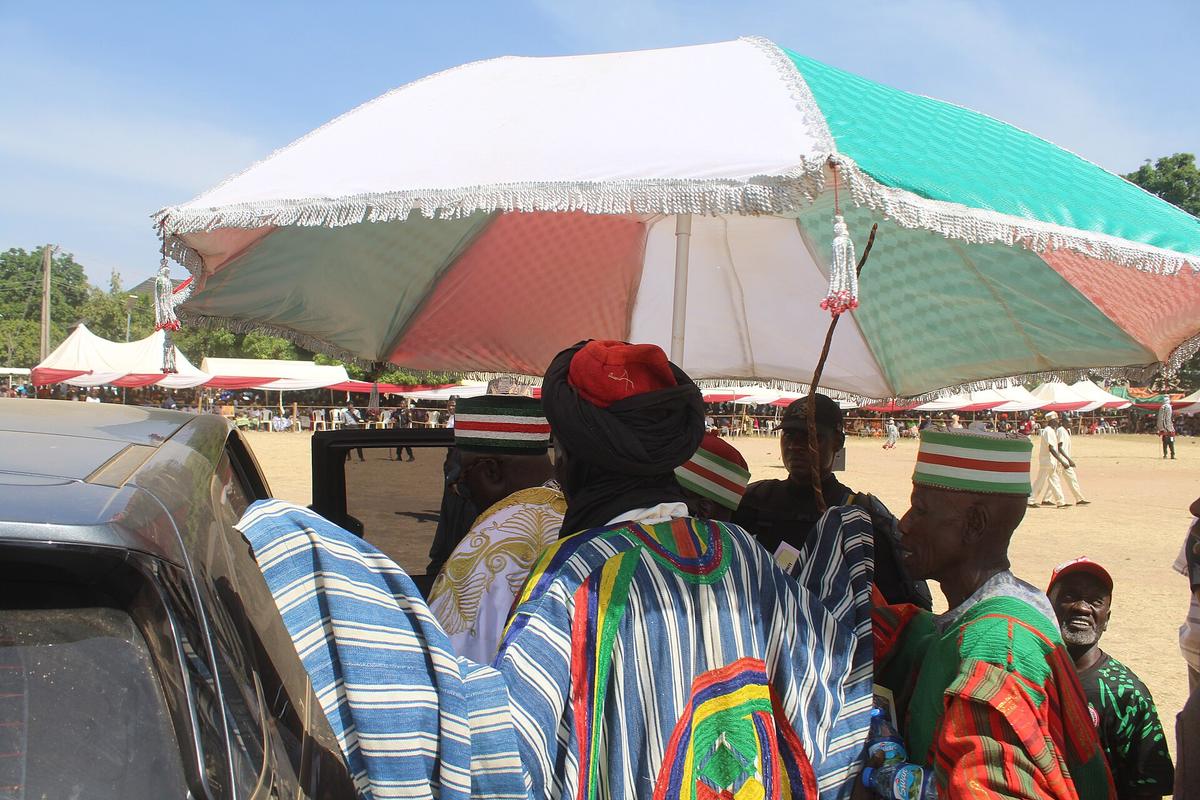
Among the Yoruba of southwestern Nigeria, the traditional engagement ceremony, idana, is a multi-stage event that can outlast the Western-style wedding it is often paired with. The sequence begins with the mo mi i mo e, an introduction where the groom's family formally requests the bride's hand. Then comes the idana proper. The groom's family arrives at the bride's family home with gifts: cash, kola nuts, drinks, fabric, a Bible or Quran depending on the family's religion. The bride's family receives them one by one. Each gift is announced and its significance explained.
The Gift as a Message
The bride price, called owo ori, is paid during this ceremony. It is explicitly not a purchase. It is a token of the groom's ability to provide, and the bride's family typically gives a portion back as a gesture of goodwill. The owambe is the reception that follows, a lavish public celebration with music, dancing, and a guest list that can run into the hundreds. The word owambe has come to mean, in Nigerian popular culture, a party where no expense is spared and the whole community is expected to attend.
What the idana means to the Yoruba is that marriage is a contract between families, witnessed by the community. The bride price is the formal record of the groom's commitment. The gift exchange is not decorative. Each item is a message. Kola nuts are a sign of respect and a request for the ancestors' blessing. The Bible or Quran signals which religious rite will follow. The bride's family's acceptance of the gifts is the moment the union becomes real. The owambe is the public declaration that both families can mobilise resources and hospitality on a grand scale. The collectivist ethos is explicit: the couple's bond is a new node in an existing network of kinship obligations. The size of the celebration reflects the families' standing, not just the couple's feelings.
Rules for Guests
If you are a guest at a Nigerian wedding, the practical rules are simple. The owambe is not optional attendance. Your presence is the point. Leaving before the reception ends is a slight to the families. Bring a gift in cash, wrapped and labelled with your name. The idana, by contrast, is a family affair. If you are not a relative or close friend, you will not be invited. The failure case is treating the owambe like a Western cocktail hour and staying for an hour. The event runs until late, often past midnight. The dancing is not a performance for guests but a communal activity. The cultural contingency of love is on full display here. The wedding's meaning is the public redistribution of resources and recognition. The couple's private commitment is the smallest part of the event.
Cultural Love Traditions Around the World: What the Detail Teaches About Your Own Assumptions
Step back from the individual cases and the pattern is unmistakable. In the Minangkabau, Hmong, Yoruba, and Japanese traditions, the wedding is a mechanism for aligning kinship groups, transferring obligations, and securing community witness. The couple's emotional life is a private matter that the ceremony does not need to prove. In several cases it is explicitly expected to develop after the public commitment. This is not a deficiency of feeling. It is a different emotional expression norm, one where love is demonstrated through family loyalty and practical provision rather than through public declarations. The companionate marriage, by contrast, makes the couple's feelings the entire justification for the union. The wedding becomes a stage for performing those feelings. Both are real. Both are learned. Neither is a universal truth about what love is.
Your Model Is One Option Among Many
The love expression cultural variation is not a list of exotic customs to marvel at. It is evidence that the way you express love, the words you expect to hear, the gestures you read as meaningful, the wedding you imagine for yourself, is a product of a specific time and place. The companionate marriage emerged in the 20th century in Western societies. Its dominance is a historical accident, not a biological inevitability. The ethnographic description of these traditions is not a tourist's curiosity. It is a mirror. When you read about the owo ori or the san-san-kudo or the levirate, you are not learning what 'other people do'. You are learning that your own assumptions are one option among many. That option comes with its own costs: the pressure to perform, the isolation of the couple from the community, the expectation that love alone can sustain a partnership through the transition to parenthood and the exhaustion of the first year.
For the culturally curious reader, the action is to hold your own model lightly. If you are planning a wedding, ask what job you want the ceremony to do. Express your private feelings, or bind your families and community? The answer is not predetermined by the companionate model. If you are a parent in the first year after a baby arrives, watching the partnership recede behind exhaustion, the traditions above are a reminder. Unions have been sustained for centuries by structures larger than the couple's feelings: kinship networks, community obligations, economic interdependence. The modern expectation of the partner as everything is a recent and heavy assignment. The specific skills of a businesslike alliance, dividing cognitive labour, tracking the mental load, agreeing on conflict recovery time of minutes not days, are the contemporary version of what older traditions did structurally.
What the Companionate Model Misses: The Businesslike Alliance Skills
The traditions above are not a recommendation to abandon the companionate model. They are a corrective to its blind spot. The companionate marriage asks the couple to be each other's everything: emotional support, co-parent, financial partner, best friend. It offers no institutional scaffolding for the parts that are not romantic. The older traditions had scaffolding built in. The kin group absorbed conflict. The community witnessed the contract. The bride price created a formal obligation that both families were invested in maintaining. When that scaffolding is absent, which is the situation for most modern couples, the skills that keep the partnership running are not romantic at all. They are the skills of a small business: clear division of labour, explicit agreements, and a protocol for when things go wrong.
The Research on What Holds
The research on relationship satisfaction is blunt about the mechanics. The Gottman 'magic ratio', 5 positive interactions to 1 negative interaction during conflict, and 20 to 1 outside it, was derived from a specific sample of heterosexual married couples in a laboratory in the 1990s. The 5:1 figure is a group-level finding with individual variation. The 'softened start-up', a complaint beginning with 'I feel' rather than accusation, is trainable. The 'four horsemen' of criticism, contempt, defensiveness, and stonewalling are behaviours, not personality traits. Contempt, the expression of superiority through sarcasm or eye-rolling, is the single best predictor of divorce in that research. Stonewalling is not the same as taking a break. It is physiological flooding, with no agreed return time. The person flooded cannot process information or access humour.
The mental load, the invisible cognitive work of noticing, planning, and tracking, is structural, not personal. It is the thing the older traditions never had to name because the division was fixed by kinship. None of this is the point of the wedding, but it is the point of the marriage. If you are newly engaged, the practical takeaway is to spend as much time planning the division of labour and the conflict protocol as you spend on the seating chart. The wedding debt hangover, the financial strain that persists into the first years, is a direct result of treating the event budget as separate from the marriage's financial foundation. The milestone assumption, that engagement, marriage, or a baby will resolve existing problems, is a cultural script that the research does not support. The transition to parenthood satisfaction decline is real. It does not return to pre-birth levels for most couples through the child's adolescence. The couple that survives it has agreed in advance on who does what, and has a system for renegotiating when the exhaustion hits.
Companionate Marriage History: The Shift You Are Living Inside
The companionate marriage history is not a footnote. It is the story of how the Western wedding became what it is. Before the 20th century, and still today in many parts of the world, marriage was primarily an economic partnership and a kinship alliance. The bride's family transferred a dowry or received a bride price. The groom's family gained labour and new kinship ties. The couple's children were the heirs to both lines. Love was a hoped-for bonus. The wedding was a contract signing witnessed by the community.
How the Inversion Happened
The companionate model inverted this. Emotional fulfilment became the stated purpose. Personal choice replaced family negotiation. The wedding became a public performance of the couple's private feelings. The shift was not the result of some natural evolution toward 'better' marriage. It was the product of specific historical changes: industrialisation, urbanisation, women's economic dependence shifting, the rise of individualism. These made the older economic logic less central.
The result is a marriage system with enormous emotional ambition and very little structural support. The couple is expected to be each other's everything. When the partnership fails, the divorce rate in the US has hovered around 40 to 50 percent for decades, the failure is experienced as a personal tragedy rather than a structural flaw. The traditions in this guide are not a return to the past. They are a reminder that the present is not the only possible configuration. The companionate model is a regional, historical product. Understanding that is liberating. It means the problems you are facing, the mental load, the conflict patterns, the post-baby collapse, are not your personal failures. They are the predictable strains of a system that asks two people to do the work that a whole community used to do.
For the separated co-parent, the lesson is practical. You are now running a child-rearing partnership with someone you are no longer romantically tied to. The skills are exactly the businesslike alliance skills the companionate model devalued: explicit agreements, scheduled communication, a division of labour that is reviewed and revised. The older traditions never pretended the emotional bond was the thing that made the partnership work. They built the structure first and let the feelings grow inside it. You are doing the same thing now, without the ceremony. That is not a failure of love. It is a return to the older logic, where the alliance is the point.
Who This Subject Suits, and Who Should Skip It
The traditions described here suit the culturally curious reader who wants to understand their own relationship assumptions as products of history and region rather than as universal truths. That reader is likely planning a wedding, recovering from one, or in the thick of the transition to parenthood. The detail of the Minangkabau bride price or the Hmong capture negotiation clarifies something genuinely: the problems of the companionate model are not inevitable. The skills of a businesslike alliance are not a betrayal of romance. The subject also suits the separated co-parent who needs permission to treat the partnership as a practical arrangement. It suits the newly engaged couple who need to hear that the wedding is a planning problem, not a relationship solution.
It does not suit the reader who wants a quick list of exotic customs to share at a dinner party. This guide refuses that format by design. It also does not suit the reader in an actively abusive relationship. The collectivist traditions above are not a model to emulate. The kinship structures that support a healthy marriage can also enforce an abusive one. Help is specific and should be found directly. And it does not suit the reader who believes love is a universal feeling that simply wears different clothes in different places. The evidence here is that the feeling itself is shaped by the culture that names it. If you are that reader, you will find the detail tedious rather than illuminating. If you are not, the detail is the point.
Frequently Asked Questions
Is the bride price the same as buying a wife?
No. In the Minangkabau, Yoruba, and Hmong traditions, the bride price is a formal transfer that establishes the groom's seriousness and the families' mutual obligation. It is not a market transaction. The bride's family typically gives part of it back as a goodwill gesture. The payment is a record of a kinship alliance, not a purchase.
Do arranged marriages produce less happy couples than love marriages?
Research on Japanese omiai and other arranged systems has found no consistent difference in reported marital satisfaction. The distinction between arranged and companionate marriage blurs in practice. Arranged marriages often include mutual consent and a courtship period. Love marriages are shaped by family expectations. Satisfaction is not tied to how the couple met.
Is marriage by capture still practised and is it always coercive?
It is illegal in Laos and criticised in Hmong diaspora communities. It has real victims when the script breaks down. The traditional form usually involved the woman's prior knowledge and cooperation. She could refuse to sleep in the groom's house. The practice is not a simple case of coercion. Any honest account holds both truths.
Does the companionate model cause the transition-to-parenthood satisfaction drop?
Not directly. The model's demand that the partner be everything, emotional support, co-parent, financial partner, leaves no structural support when the baby arrives. The satisfaction drop is real and does not return to pre-birth levels for most couples through the child's adolescence. Traditions with kinship scaffolding avoid this by distributing the load.
The One Claim That Cannot Appear on a Competitor's Page
The sentence that could not appear on another page about how cultures celebrate love is this: the Gottman 'magic ratio' of 5 positive to 1 negative interactions was derived from a specific sample of heterosexual married couples recruited via newspaper ads in the 1990s, and it is a group-level finding with individual variation, not a universal law, and not a target you have failed to hit if you fall short on a particular Tuesday. Most relationship advice treats it as a fixed rule. This page treats it as a finding with a provenance, which is the difference between a fact and a fetish.
More in this guide
Tinder vs Hinge Comparison: Volume Against Intent and Why Profile Format DecidesOkCupid vs Coffee Meets Bagel Comparison: Questions or Scarcity to Solve SwipingLighthouse Parenting: The Popular Label and the Older Evidence Base It Rests On.
Read next
-
 Tinder vs Hinge Comparison: Volume Against Intent and Why Profile Format Decides
Tinder delivers volume; Hinge filters for intent. The same person gets very different results from each, and the reason is the profile format rather than the user base.
Tinder vs Hinge Comparison: Volume Against Intent and Why Profile Format Decides
Tinder delivers volume; Hinge filters for intent. The same person gets very different results from each, and the reason is the profile format rather than the user base.
-
 OkCupid vs Coffee Meets Bagel Comparison: Questions or Scarcity to Solve Swiping
OkCupid uses questions; Coffee Meets Bagel uses scarcity. Both solve the endless-swiping complaint differently—which suits depends on patience and city size.
OkCupid vs Coffee Meets Bagel Comparison: Questions or Scarcity to Solve Swiping
OkCupid uses questions; Coffee Meets Bagel uses scarcity. Both solve the endless-swiping complaint differently—which suits depends on patience and city size.
-
 Best Dating Apps for People in Their 30s and 40s Who Want Dates Not Pen Pals
Which dating apps actually suit daters in their 30s and 40s, based on user-base age skew, profile depth, and mechanics that reward substance over snap judgements.
Best Dating Apps for People in Their 30s and 40s Who Want Dates Not Pen Pals
Which dating apps actually suit daters in their 30s and 40s, based on user-base age skew, profile depth, and mechanics that reward substance over snap judgements.
-
 Best Dating Apps for Serious Relationships: Ranked on Intent, Depth and Effort
The best dating apps for serious relationships ranked on what matters: stated intent, profile depth, and whether the format rewards effort over volume—plus what each costs in attention.
Best Dating Apps for Serious Relationships: Ranked on Intent, Depth and Effort
The best dating apps for serious relationships ranked on what matters: stated intent, profile depth, and whether the format rewards effort over volume—plus what each costs in attention.